
INFO
This website presents a library of West African rhythms played on djembe and dunun. We’ll start by studying Malinke rhythms from Upper Guinea (Hamana, Gberedu and Sankaran regions), in homage to the beauty and richness of Mandinka music.
Our team members have been passionate about djembe and dunun for over 25 years. Faced with the difficulty of finding precise and detailed information throughout his apprenticeship, the founder Maarten Schepers decided in January 2021 to create this project.
Djembe Videos is aimed at both professional musicians from all cultural backgrounds, amateurs, enthousiasts, students and teachers of African percussion.
The shared content is far from exhaustive. It is essential to know that the rhythms vary according to the villages, the drummers, and that they can evolve over time. We try to present different versions to illustrate this.
The content of the site, drawn from thousands of audio and video extracts, does not replace learning from experienced musicians during workshops or classes.
DJEMBE SOLOS
The djembe solos presented on this site are inspired by original solos played by West African musicians.
They are created like puzzle pieces, which fit together to create complete solos. Only a few key phrases are played, the aim being to understand how they fit together in the context, interacting with the song, the dance and the dununs.
We invite you to listen to as many recordings as possible (see discography) to better understand the context, the various styles and techniques of experienced players.
It is essential to master the dunun and accompaniment parts well before starting to play solos.
DUNUNS
The dunun parts have been classified according to their similarity, not their provenance.
In real context, sangban and dununba variations are played simultaneously, intersecting to create original polyrhythms.
Each variation can be played once or be repeated, adapting to the songs, the dance and the inspiration of the moment. Some musicians don’t play the closed strokes on the sangban.
The choice and sequence of rhythms depends on the context, the musicians, the ceremonies, the singers and the dancers.
For each rhythm, learning the basic patterns, a few variations and “chauffes” is more than enough.
We recommend focusing on quality over quantity. It is very important to develop precision, regularity, endurance, intensity, and to know how to perfectly superimpose the different rhythmic parts.

VIDEOS
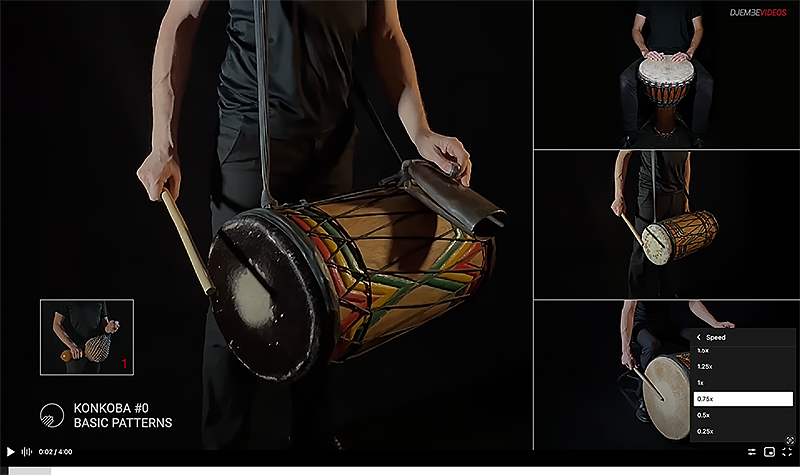
Each video starts with 2 measure count in played on the yabara (shekere).
Using the settings menu, you can slow down the videos when needed.
MAPS
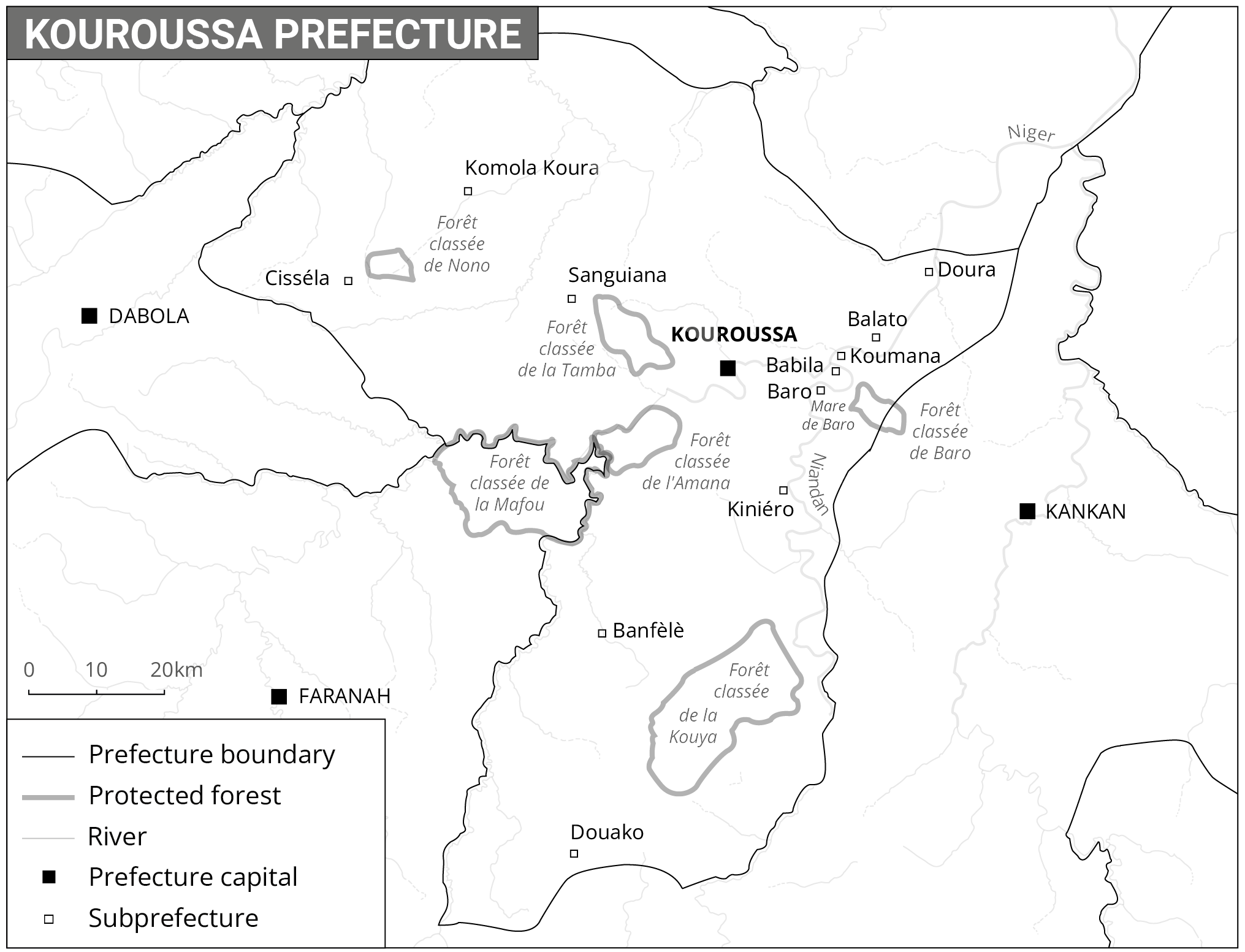
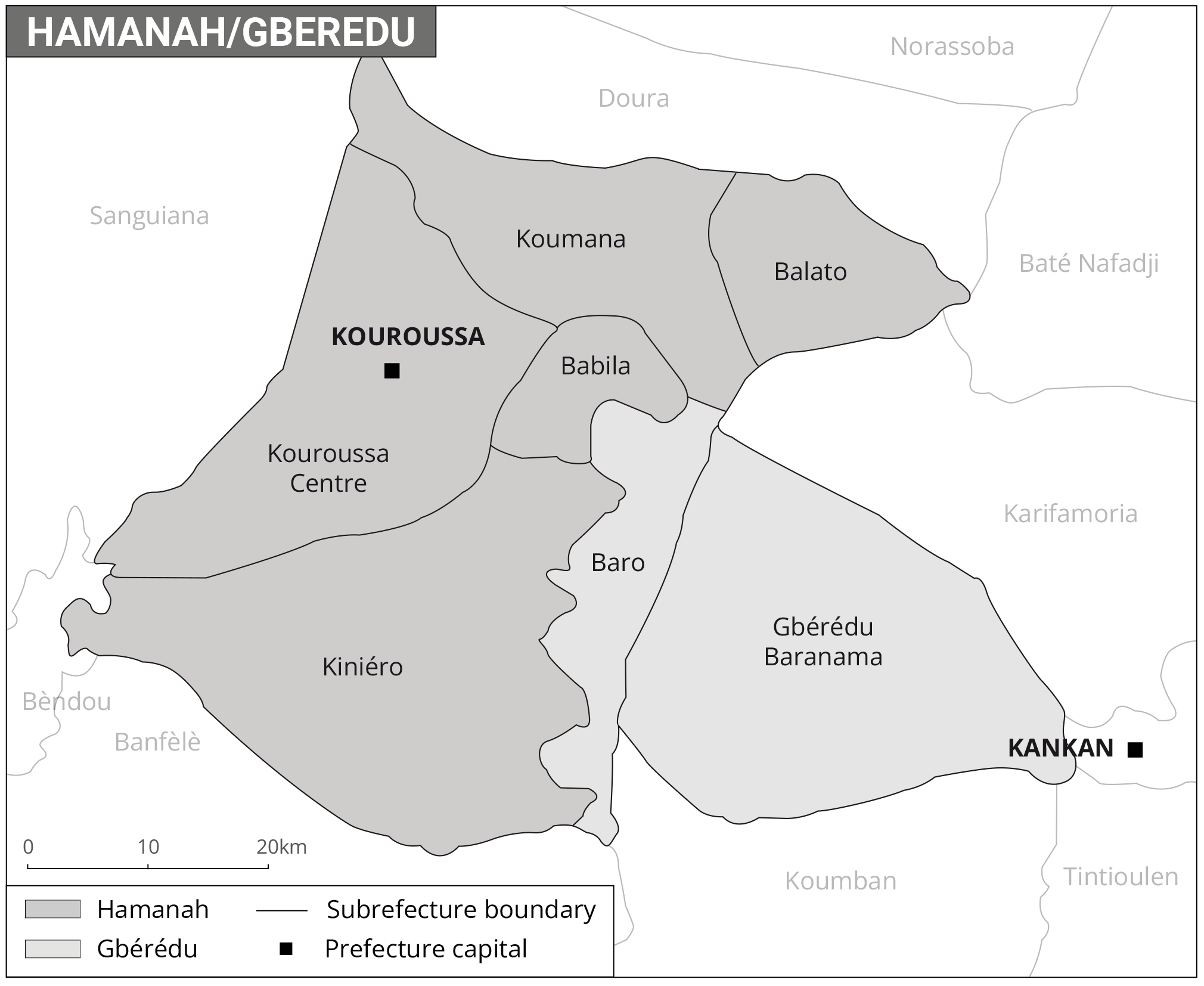
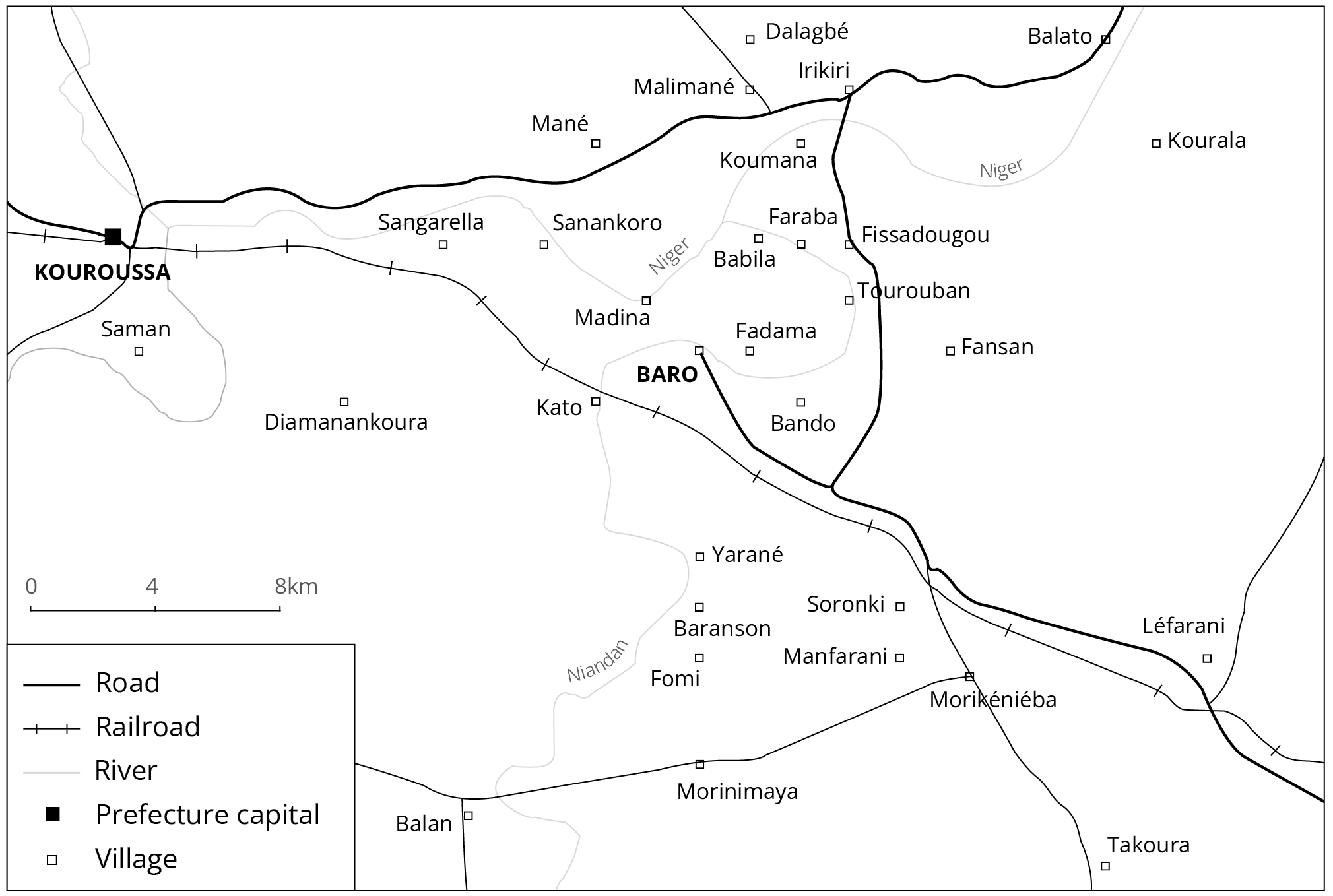
Below are four maps about Guinea, the Kouroussa prefecture, the Hamana/Gberedu region, and a more detailed map centered around Baro.

INFO
This website presents a library of West African rhythms played on djembe and dunun. We’ll start by studying Malinke rhythms from Upper Guinea (Hamana, Gberedu and Sankaran regions), in homage to the beauty and richness of Mandinka music.
Our team members have been passionate about djembe and dunun for over 25 years. Faced with the difficulty of finding precise and detailed information throughout his apprenticeship, the founder Maarten Schepers decided in January 2021 to create this project.
Djembe Videos is aimed at both professional musicians from all cultural backgrounds, amateurs, enthousiasts, students and teachers of African percussion.
The shared content is far from exhaustive. It is essential to know that the rhythms vary according to the villages, the drummers, and that they can evolve over time. We try to present different versions to illustrate this.
The content of the site, drawn from thousands of audio and video extracts, does not replace learning from experienced musicians during workshops or classes.
DJEMBE SOLOS
The djembe solos presented on this site are inspired by original solos played by West African musicians.
They are created like puzzle pieces, which fit together to create complete solos. Only a few key phrases are played, the aim being to understand how they fit together in the context, interacting with the song, the dance and the dununs.
We invite you to listen to as many recordings as possible (see discography) to better understand the context, the various styles and techniques of experienced players.
It is essential to master the dunun and accompaniment parts well before starting to play solos.
DUNUNS
The dunun parts have been classified according to their similarity, not their provenance.
In real context, sangban and dununba variations are played simultaneously, intersecting to create original polyrhythms.
Each variation can be played once or be repeated, adapting to the songs, the dance and the inspiration of the moment. Some musicians don’t play the closed strokes on the sangban.
The choice and sequence of rhythms depends on the context, the musicians, the ceremonies, the singers and the dancers.
For each rhythm, learning the basic patterns, a few variations and “chauffes” is more than enough.
We recommend focusing on quality over quantity. It is very important to develop precision, regularity, endurance, intensity, and to know how to perfectly superimpose the different rhythmic parts.
VIDEOS
Each video starts with 2 measure count in played on the yabara (shekere).
Using the settings menu, you can slow down the videos when needed.
MAPS
Below are four maps about Guinea, the Kouroussa prefecture, the Hamana/Gberedu region, and a more detailed map centered around Baro.